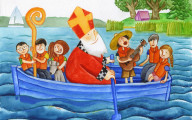

For the past three years, in cooperation with the Polish Humanistic and Experiential Association (former INTRA Association), we have been running the St. Nicholas Therapeutic Haven. Over that time, we have managed to provide more than 5,200 hours of free therapy in the Ukrainian language for refugee children in mental crisis. We are able to run the place thanks to the generosity of our donors, for which we are very grateful. Take a minute to read the interview below with psychotherapists Marianna Fedorovych and Iuliia Kuzmenko, as well as psychologist Olena Masyk, who work at the Haven on a daily basis and help Ukrainian children cope with mental difficulties that prevent harmonious development.
What is the mental condition of Ukrainian children today, three years after the outbreak of full-scale war?
To a large extent, it depends on whether the children are with their families or alone in Poland, and the relationships within their families, that is, whether family members have been able to accommodate here, find work and a roof over their heads. And most importantly, whether the child has a person with whom they feel a strong bond and a sense of support. Children face many challenges. We see cases of bullying or aggression against Ukrainians in schools and on the street, because of their nationality. Some teenagers have changed schools several times due to difficult integrating into Polish educational institutions. The children who find their place best are those who have already found their community and good friends among Ukrainian peers. This community of experience and common language makes it easier for the children to integrate into the Polish environment.
Children who have been in Poland for three years are mostly already integrated, but many families have come to Poland just now, or, even though they have been there longer, something bad happens with dad on the frontline now, or a family tragedy happens, which of course translates often into a mental crisis in the child. For instance, we have a little girl who fled to Poland with her mother and siblings coming to St. Nicholas Haven. Dad is a 2022 Mariupol defender and has been a prisoner of war somewhere in Russia for several years. The elder brother was left alone in Ukraine because he turned eighteen and couldn’t flee to Poland, and the mom has been diagnosed with cancer here, in Poland. So, while it seemed that the situation was under control upon arrival, now the crisis begins.
I also work with an eight years’ old girl who continues to suffer from post-traumatic stress. She reacts to sounds so intensely that she is unable to learn, and has a speech problem. Or with a sixteen years’ old boy who fled eastern Ukraine after a massacre and is now another month unable to go to school because he is afraid of people. So he sits alone in an apartment and tries to learn online.
So the war which to us, sadly, has already faded in a way, is still leaving its mark on the lives of more Ukrainian children?
Yes, of course! The vast majority of Ukrainian children who come to the Haven either still have fathers at the front or other relatives who have stayed in Ukraine. The children are full of anxiety. There is also a lot of difficulty with Ukrainian children being in Poland exclusively with their moms. Women often work two jobs, including Saturday and Sunday. They work non-stop to support the family. They basically don’t see their children. So first, there are learning difficulties, and then behavioral difficulties, and then the mother already has to react and comes to us at the Heaven for help.
There are also children who had problems already in Ukraine and were not diagnosed there, for example, because of the autism spectrum, because they lived in tiny villages. And where these problems are compounded by post-traumatic stress after hiding in the basement for a long time, these accumulated problems are now intensified, and it is very difficult to solve them. For example, there is a boy with us whose village was shelled by a tank, and this boy was unable to study for many months – he was anxious, distracted, constantly seeing some scary figures. Now he has found help at the St. Nicholas Haven, can undergo psychiatric treatment and has returned to learning.
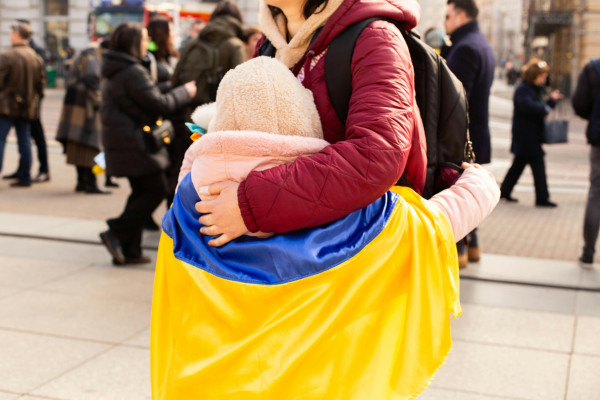
And what kind of children come to the Haven in Warsaw – those who have taken refuge in Warsaw just recently, or rather the children who have already lived in Poland for several years?
A few weeks ago, a new wave of refugees from Ukraine began. As there were shellings in Sumy, Zaporizhzhya, or Kyiv, two weeks later at our Heaven there was a queue of children in need of psychological help. Over the last three months, a wave of new refugees has been coming.
Families who did not have money to flee in the first days of the war, or took an indirect route to Poland via Russia, also come. Among the charges are also children who first escaped to Canada or Germany and did not adapt at all there. They come to Poland hoping that it will be easier for them here, because there is a closer culture, better understanding and it is closer to home. However, there is a very strong sense of confusion and instability, which further reinforces the children’s difficult mental states. These are children in deep depressions. They don’t understand why they are here, why they should go to school at all, why they should go out and meet new people. They have the feeling that they are not important to anyone in this world.
Can you tell us what are the most common difficulties faced by children who come to St. Nicholas Therapeutic Haven?
The main ones are anxiety disorders, post-traumatic stress and depression. There are quite a few children who are unable to learn. This often results in aggression, either against themselves or those around them. In our care, for example, we have a boy who keeps airplanes in his pockets all the time. A full backpack of airplanes. Full pockets of airplanes. The boy doesn’t say anything but keeps making “whoo” and playing with these planes. What’s worse, he hits other children with them. He has a lot of anger in him and can’t handle it. His dad died recently. A bomb was dropped on him from a plane. And that’s when the problems started in the child. All day long he does nothing else but play with airplanes and hit other children with them.
The anxiety is compounded by problems with integration in a Polish school. Many schools have smart teachers who support these processes and Ukrainian children and prevent violence between peers. Unfortunately, Ukrainian students are taught not to report problems to adults, and very late the difficulties they face, including peer violence they experience, bullying or depression, come to light. And children can hear for weeks that “its good that you don’t have a father, it’s good that Putin killed him,” and yet they won’t ask for help. And the subject only surfaces when the child starts being aggressive or fails a class test.
Another problem is being constantly online. Children worry all the time about their fathers on the front lines, but also about grandmothers or aunts left behind in Ukraine. Now they can follow the situation in real time, on their smartphones. And they continue to watch and see videos or photos from the front. One boy watched the deaths and executions of Ukrainian soldiers every day on Telegram’s Russian channels, because he wanted to know how his dad died. Even tiny children, such as nine-year-olds, watch very violent content on a daily basis. They can’t sleep afterwards, they scream at night out of fear, and only when they start coming to therapy we see the content these children were exposed to. We also had a boy in crisis intervention who watched videos of an execution in which a Ukrainian soldier was beheaded. And then a boy from school came to him and threatened him with a knife. Fortunately, the police were called and the school responded correctly, but the boy had a very hard time getting his fears under control and eventually ended up in a psychiatric hospital.
What are the most important needs of Ukrainian children today, in terms of their psychological well-being and peaceful development?
First of all, contact with a stable adult. Parents are often unstable or simply absent. Contact in the real world is badly needed. Not therapy or online relationships, but real contact with others. When they come to Poland in sixth or seventh grade, it is very difficult for them to get into a group and the children suffer from loneliness, lack of social relationships and bonds.
It is important that the children’s mothers also receive psychological help. We ask them, often beg them, to get help from a therapist, but they say that although they want to, they can only go online, after 10 pm, because that’s the only time when they don’t have to be at work.
Besides, a sense of stability in general is important. When parents say that we are staying in Poland for only for three to four months, and then it drags on and on, the children feel completely lost.
And to sum up our conversation, can you tell us why St. Nicholas Therapeutic Haven should continue?
Often this is the only place where a child from Ukraine can get support. Children wait to get help from us, and in the Ukrainian refugee community, the Haven is a recognized place of support. Previously, a handful of different organizations provided such support, but they have almost all closed down. Those few years ago, there were a lot of resources to help children from Ukraine; today, they are severely lacking.
The fact that our meetings are free of charge opens the possibility to offer help to those children who would probably never come to a paid session because they cannot afford it. Many parents do not have the ability to bear the cost of therapy because they earn low income in Ukraine, and send their children money whenever they can. Many people in Ukraine are now losing their jobs and prices are soaring. Parents who are here with their children are trying to pay high rent and there is never enough money for therapy.
When I tell the teenagers that this place is meant to help them adjust to life in Poland, that our goal is for them not to be left alone with their difficulties, that there are many people who care about their condition, that these people invest in psychological help, this alone helps them, it leaves a warmer trace on their hearts. They can feel that they are cared for, that there are people who are not indifferent to their suffering and loneliness.
Interview moderated by Anna Grunwald and Antonina Grządkowska.
From the bottom of our hearts, we thank our donors: Pepco, Fondation de France and the Jan Olszewski Foundation Aid to Poles in the East, thanks to which we can keep up the St. Nicholas Therapeutic Haven.
If, together with us, you want to help Ukrainian children regain their mental balance, make a donation:
SWIFT Code: PKOP PL PW
IBAN (EUR): PL95 1240 6003 1978 0010 8524 6705
IBAN (USD): PL30 1240 6003 1787 0010 8524 6561
IBAN (GBP): PL02 1240 6003 1789 0010 8524 6965
PayPal: [email protected]
To receive free therapy in the Ukrainian language as part of St. Nicholas Haven, please contact directly our partner, the INTRA Association: [email protected]